Showing posts with label A Revised History of the Era of King Hezekiah of Judah. Show all posts

Sunday, September 23, 2012

Hezekiah's Minister Eliakim was High Priest and he also points to Saint Peter


....

We first encounter Eliakim son of Hilkiah in Isaiah 22, in what is regarded as the prophet’s ‘second oracle’ against the official, Sobna (or Shebna). Isaiah predicted that Sobna will be replaced by Eliakim. I showed in the previous chapter that this took effect during Sennacherib’s Third Campaign invasion, since Eliakim was by then the king’s chief minister. Sobna was now only second in command.

But the vital question here is: What was Sobna’s former office, to which Eliakim had now succeeded? It is usually given as Major-domo or its equivalent; but the Douay Isaiah 22:15 translates it in terms that could only be referring to the high priesthood. Thus Isaiah is commanded: ‘Go … to him that dwelleth in the tabernacle, to Sobna [Shebna] who is over the Temple ...’. The Latin Vulgate gives the words italicized here as ‘eum qui habitat in tabernaculo’.

Moreover, Isaiah describes and praises Eliakim in words that indicate, not only the man’s great authority, but that could also be taken as a description of a high priest: “He shall be as a father …, to the inhabitants of Jerusalem and to the House of Judah” (v. 21). Strong words when it is considered that Hezekiah himself ruled over the House of Judah; but an appropriate title for a high priest who was, in a sense, ruler over even the king whom he would proclaim and anoint (cf. 1 Samuel 16:13).
And in Eliakim’s case, with his having had to substitute for the king whilst Hezekiah was sick, the title, ‘father’ … would take on an even more significant meaning.
....
 

For more, see: http://kinghezekiahofjudah2.blogspot.com.au/2009/01/chapter-2-thesis-revised-history-of-era.html#uds-search-results


The following is taken from:
http://www.catholic.com/quickquestions/dont-revelation-37-and-isaiah-22-point-to-christ-not-peter-as-having-the-keys-of-davi

Don't Revelation 3:7 and Isaiah 22 point to Christ - not Peter - as having the keys of David?


Full Question

Revelation 3:7 proves Christ is the one who holds the key of David, not Peter. Isaiah 22 prophesies Christ's coming and his authority rather than Peter's. Matthew 16:18 has nothing to do with either.

Answer

As the royal son of David, Christ is the owner of the key of David, but this doesn't mean he can't give to Peter, as his "prime minister," the keys to his heavenly kingdom.
In the passage to which Revelation 3:7 alludes, Isaiah 22:20-23, Eliakim is made master of the palace, a post roughly equivalent to prime minister. As the king's right-hand man, the master of the palace is given the "key of the House of David."
Keys symbolize authority, so bestowing the key to the House of David upon Eliakim is equivalent to giving him, as the king's duly appointed representative, authority over the kingdom.
Revelation 3:7 speaks of Jesus as the "holder of the key of David." Some argue this means he fulfills the role Eliakim foreshadowed in Isaiah 22:20-23. They claim this excludes a prophetic application of this text to Peter by Christ in Matthew 16:18-19.
There's a problem with this argument. In Isaiah 22 Eliakim is master of the palace--the king isn't. Eliakim possesses the key of the kingdom not as its owner, but as one deputed to oversee the king's affairs. If we apply this to Christ, then we must conclude he's not the true messianic king, merely his prime minister, the Messiah's chief representative!
Although Jesus is called the "holder of the key of David" in Revelation 3:7, he doesn't hold it as Eliakim did. As the son of David, Jesus is the heir to the throne of his ancestor (Lk 1:32-33). He really is the king, not the master of the king's palace, as was Eliakim. As king, Jesus is free to bestow the keys of his kingdom on whomever he wishes--without losing the authority those keys represent.
It's the Catholic position that this is precisely what Jesus does in Matthew 16:18-19. Peter identifies Jesus as the Messiah, which means, among other things, acknowledging his kingship. Christ then shows his kingly authority by bestowing on Peter something only the king could give--the keys of the kingdom of heaven--thus making Peter the messianic equivalent of Eliakim.

Wednesday, June 23, 2010

Thesis: A Revised History of the Era of King Hezekiah of Judah and its Background

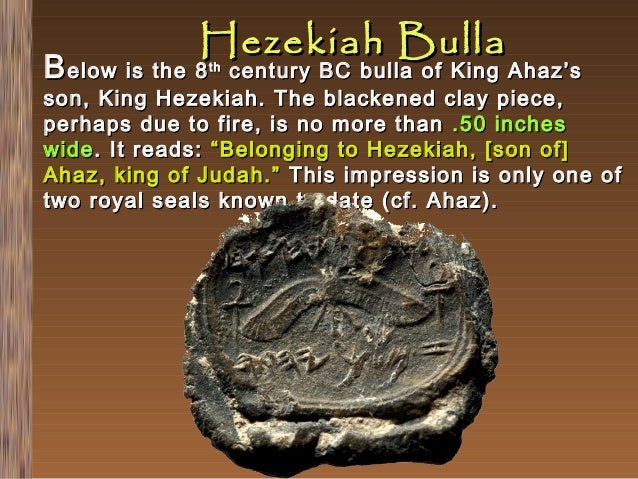
Image result for hezekiah found seal

Title: A revised history of the era of king hezekiah of judah and its background

Authors: Mackey, Damien

Keywords: revised history chronology

Issue Date: 2007

Publisher: University of Sydney.

Department of Hebrew, Biblical and Jewish Studies

Abstract: Abstract The reason why I have called this thesis a revised history for the era of king Hezekiah, and for the background to that era, is because my reconstruction of this particular period of the history of ancient Israel and of the nations associated with it will depart quite significantly from the standard text-book versions of it. My justification for blazing this unique historical trail stems from the comments made by examiners of my 1993 MA thesis, The Sothic Star Theory of the Egyptian Calendar, to the effect that: (a) I had shown the conventional chronology of ancient Egypt - to which that of the other nations (such as Assyria, Babylonia, Israel, Ethiopia and Greece) is largely tied - to be quite unsound, and that therefore, (b) the way lies open for ‘a more acceptable alternative’. Basically, this thesis is that ‘alternative’ as I see it for the era of king Hezekiah of Judah (late C8th BC), and for the background to that era (largely commencing early C9th BC). This new thesis will be an in-depth chronological analysis and realignment of the era of Hezekiah and its background with a special focus upon trying to determine, in a revised context, who were the Judaean king’s major contemporaries and what were their origins. Though Hezekiah’s era is generally quite a well-documented one, I expect to show in this thesis that it nevertheless stands in need of a substantial renovation, due especially to the over-extended Egyptian Sothic chronology and its effect upon the current version of neo-Assyrian history with which biblical historians have attempted to align the reign of king Hezekiah. The renovation to be undertaken in this thesis will reveal the era of Hezekiah to be in fact a most complex one; a meeting place for some extremely significant events in the history of Egypt/Ethiopia, Anatolia, Syro-Palestine, Greece and Mesopotamia. Introductory Section I review in Chapter 1, in a general way, the problems associated with the faulty chronology of Egypt, after having, in the Introduction, set the historical scene for Hezekiah, identifying the major nations at his time, and hinting at where the problems may lie and what sort of solutions will be proposed. A new set of chronological ‘anchors’ for the reign of king Hezekiah will be suggested. VOLUME ONE: A CHRONOLOGICAL REALIGNMENT OF KING HEZEKIAH AND HIS CONTEMPORARIES Part I: In Search of ‘A More Acceptable Alternative’ to the Conventional Background for the Era of Hezekiah In Chapter 2 I take an initial step back in time, in order to introduce a conglomerate of new peoples who appeared in the ancient Near East - ‘Indo-Europeans’ as I shall be generally calling them - amongst whom, as I shall argue, were the ancestors of some of the most important kings of Hezekiah’s day. Following on from this will be the introduction, in Chapter 3, of an early C9th BC king - arising from these immigrant peoples - whom I shall proceed to identify as a great ancestor-king, affecting major kingships contemporaneous with Hezekiah. This background analysis will continue on into Chapter 4, into the mid-late C9th BC, with the introduction of a second significant king, generally thought to have been a descendant of the first, who will be of crucial dynastic importance affecting Hezekiah’s time, especially in regard to Egypt. Part II: King Hezekiah and His Mesopotamian Contemporaries Revised In this section I consider the problems that specifically relate to the era of king Hezekiah and his connections primarily with Mesopotamia (mainly Assyria and Babylonia). In the first chapter, on Judah/Israel (Chapter 5), I examine the chronology of Hezekiah’s reign in its relation to the kingdom of Israel and the major events associated with the latter. Of special interest here will be the incident of the fall of Samaria. I shall, in regard to this incident, reconsider, and alter, the current dates for king Hezekiah himself; these, I shall argue, being based upon a faulty chronology of Assyria. Related to all of this will be Chapter 6, my lengthy revision of neo-Assyrian history, in which I shall arrive at some quite startling conclusions that will serve to shave off thirty years or more from the conventional estimate. Only as a result of these reduced dates though, shall I argue, can there be attained a proper correspondence between king Hezekiah and his Mesopotamian contemporaries, with the resulting chronological realignment becoming the very foundation stone for a new chronology of Judah/Israel. This revision will continue on into Chapter 7, with Babylonia. There I shall examine the major problems and propose solutions that I think will serve to bring a chronologico-historical harmony and alignment right across the board. Part III: King Hezekiah and His Egyptian Contemporaries Revised An even more complex task than attempting to bring into proper alignment the history of Mesopotamia for the Hezekian era will be that of grounding king Hezekiah’s Egypto-Ethiopian contemporaries. My discussion here will be dependent upon the conclusions already reached in Part I, in relation to the two seminal kings of foreign origin discussed there in detail. In Chapter 8, I shall set out in summary form all of the major Egypto-Ethiopian activity - and its agents - thought to have been concurrent with the reign of king Hezekiah. Then, in Chapter 9 and Chapter 10, respectively, I shall focus upon the influence, on the nation of Egypt, of those two seminal kings already discussed, with a view later to identifying in the fullest possible way all of Hezekiah’s major Egypto-Ethiopian contemporaries. Chapter 11 will afford me with the opportunity of bringing the revised history right to the dawn of the era of Hezekiah; whilst in Chapter 12, now fully within the Hezekian era, I shall finally be able to propose specific answers - based on my lengthy (of necessity) revision of the background Egyptian history - to what will have turned out to be two extremely difficult questions to answer: namely, Who were king Hezekiah’s main Egypto-Ethiopian contemporaries (and what were their origins)? and: To which dynasties did these particular pharaohs belong? VOLUME TWO: SENNACHERIB’S INVASIONS OF HEZEKIAH’S KINGDOM AND HIS DEFEAT Part I: Sennacherib’s Invasions of King Hezekiah’s Kingdom Having attempted to establish, in VOLUME ONE, a most comprehensive, revised alignment of king Hezekiah with all of his major contemporaries, from Egypt/Ethiopia to Mesopotamia, I now proceed to tackle vexed problems associated with the king’s reign in regard to the incursions of Assyria into the Judaean kingdom. For example: Did Sennacherib king of Assyria launch a major attack on Jerusalem once or twice? and: What actually happened to Sennacherib’s army of 185,000? My revision of neo-Assyrian history has now hopefully made it possible for me to provide a firm answer to the first question, to which I shall dedicate Chapter 1. Part II: Demise of the Assyrian Army and of Sennacherib To answer the second question, I shall be drawing also upon the pseudepigraphal Book of Judith in Chapter 2 and Chapter 3. This action-packed book holds, I believe, the very key to what happened to the ill-fated Assyrian army. But I must at the same time fully integrate the Book of Judith with Kings, Chronicles and Isaiah for the era of Hezekiah so that there can be no doubt about the former’s relevance. This detailed work will simply be an extension of VOLUME ONE, in which I had sought to confirm who were king Hezekiah’s contemporaries. But it will also add a fascinating new dimension to it. The Epilogue will provide me with an opportunity to discuss the aftermath of the Assyrian defeat and what befell some of the leading characters whom we shall have encountered. It will also serve as a lead-in to my Excursus on Isaiah, whose primary purpose will be to highlight the prophet’s celebrated rĂ´le - according to this revision - in Assyria, subsequent to Israel’s victory. A reconstructed history (chronology) needs a revised stratigraphy to underpin it all. Throughout this thesis I shall also be endeavouring to lay down a sound, basic stratigraphy for king Hezekiah and his contemporaries and for the background to Hezekiah’s era.
Description: Master of Arts
URI: http://hdl.handle.net/2123/5973
Appears in Collections: Sydney Digital Theses


Please use this identifier to cite or link to this item: http://hdl.handle.net/2123/5973